
 This is the first collage I have made for a couple of years, and comes from my continuing experiments with latex. It is about 70 x 50cm, on greyboard.
Showing posts with label art. Show all posts
Showing posts with label art. Show all posts
Wednesday
Jerusalem
This is the first collage I have made for a couple of years, and comes from my continuing experiments with latex. It is about 70 x 50cm, on greyboard.

Tuesday
Atlas|Shadow
 I intend the contents of The Eisegete's Study to each have a digital 'shadow': an image further elaborating the object and its symbolic interconnections that will take the form of a card. These cards will be gathered together in The Card Index, a further part of the Study which will itself have both a physical and digital form.
Monday
a
 This sketch is from a series of pieces I made about diagrams and reading. It's around 31 x 57cm, made using a mapping pen and goose quill. During my 12keys project of 2005, I became interested in different grammars of drawing, in how - if the weighting is wrong - the object of a labeled diagram can seem to be sprouting antennæ and feelers. How swashes and flourishes need to be 'read through' to make sense of a letter.
The Labyrinth
 I made this in 2006, whilst investigating the structure of the inner ear and the path which songs travel in
my head. It's made using acrylic, pastel, graphite and gold ink, on a piece of laid Dorset paper about 33 x 57cm. The ear is cribbed from Grey's Anatomy.
full stop.
 This little strange piece I made for the MORTAL show but decided against exhibiting. It would have been eclipsed by 'the a game', sending out an even more confused message than that deliberately polyphonic, encyclopædic folly does on its own. The fragment of bone is from my mother's medical school skeleton. I don't know if it is still the case, but when my parents were at medical school in London each student had two skeletons; their own and another. All that remains of my mother's is a mess of bones in a white plastic bag, missing most parts but with some curious additions. How does one acquire a spare jaw?
If respect even comes into it, is using a part of some unknown body to make a work of trite art worse than leaving it in a bag? Somehow I couldn't bring myself to set scalpel to that fragment of spongy bone. Somehow I ended up shaping it with my teeth, picking at it with my nails as if it were part of my own body. How small a part of someone is taboo? Some cells are more sacred than others, even now. Eggs and seed. The chest was already broken, using it was a little step.
Tuesday
Temporal Meditation (The Black Queen's Pawn)
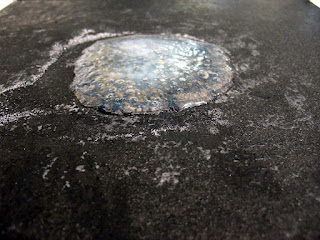
 This is an initial 'sketch' for the Black Queen, one of the pieces of round two of 'the a game'. It is about 19 x 22 x 26cm and made from 15m of knotted seagrass, stained with indian ink. While making it I had to improvise some thimble-like finger guards from masking tape as the repetition of movements involved in knotting the fibre began to wear away at my skin. The final version will be larger and act as a kind of crystallized performance; I will attempt to knot a longer rope of seagrass fibres in one sitting meditation. Temporal is a weak pun on time and neuroanatomy.
My recent work has been moving towards aspects of process and performance, and not only in durational, endurance activities such as this and my network drawings: I have found that the aspect of exhibiting my work that is most exciting is the opportunity to use the work as a seed and a site for dialogue with the public.
Recursive Colophon
 This is the first purely typographic work I have made in several years. All my typecraft owes a lot to the work of pioneering typographers like Wolfgang Weingart and John Maeda. This particular experiment is, as you can probably tell, a joke about fractals executed in thrice-blesséd Hoefler Text. I plan to make a steadily fading version with even more iterations, but fear for the safety of my computer. Still, as my brother continually tells me, art is all about knowing when to stop.
I've just noticed the similarities between this image and the black beams in the post below. Coincidence? Yes.
Sunday
MORTAL
 I have just returned from installing and de-installing The A Game from my first "proper show". (The Organiser of the show was very pleased when I told him it was a 'proper show'; the project apparently started small and moderate and then grew...) This is a picture from the MORTAL website www.mortal.org.uk. Unfortunately all the picture Liz K and I took are very blurry, whether from the dark or the drink. As you can see, my giant piece (I recently found out that it weighs some 80 kilos) has pride of place in the middle of the huge red carpet. I can honestly say when I made the piece, having in mind the vast concrete floor at Paintworks, I never expected to install it on a red carpet. I was very pleased with the result.
Friday
Flexible Territory
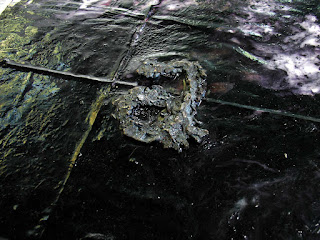
WEB.jpg) This was made using latex and transfer type and is approximately a meter square. It is a "print" taken with liquid latex from a folded metal sheet stained with earth and ash, on which a fire had been set that burned through the center of the metal. The dried latex was then carefully and laboriously peeled from the sheet. Adding the rhumb lines was tricky as latex doesn't take ink particularly well, but I was pleased at how well the transfer type adhered. At this size, it is quite difficult to spot (look for a small number of scattered white letters).
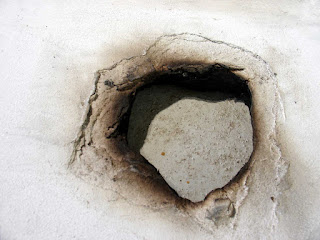
This was made using latex and transfer type and is approximately a meter square. It is a "print" taken with liquid latex from a folded metal sheet stained with earth and ash, on which a fire had been set that burned through the center of the metal. The dried latex was then carefully and laboriously peeled from the sheet. Adding the rhumb lines was tricky as latex doesn't take ink particularly well, but I was pleased at how well the transfer type adhered. At this size, it is quite difficult to spot (look for a small number of scattered white letters).I have been meaning for some time to make a flexible piece that was both map and territory. Ragged coastlines and damaged documents share a certain quality of torn, fractal edge, that sense of the 'giantiny' I mentioned in the Found Paintings post.
Wednesday
Found Paintings
 I took these digital photographs at the Bristol School of Art. This kind of suface is the result of layers and layers of accidental painting and repainting. Contriving to produce such a surface rather defeats the point, and (like the difference between distrssed furniture and an antique) often looks daft. Of course, the act of framing a section of a rich, paint-spattered environment is a powerful one. Compositional beauty (perhaps all beauty) lies in the correct application of a grid, and I am no photographer. Often, the beauty my eye finds in these found paintings in the environment relies on a semi-conscious editing out. I cannot photograph what I see.
 I have a passionate attraction to all things distressed, dirty, moldy, verdigris or patinated. Looking at lichen or the cracks in leather can occupy me for hours. I think it has something to do with the scale-invariance; aerial photographs and microscopy have much in common. Staring into rockpools, I lose my sense of scale. For a feverish moment, my sense of myself expands and contracts at the same time.
 I seem to loom, ballooning, yet simultaneously, vertiginiously, to dwindle down to a mote. I call this sense 'the giantiny'. Along with this scale trick, the kind of surfaces in which I find most pleasure have that quality of Leonardo's Wall (which many men have spat upon). Yet even this rich hallucinatory material does not fully explain the almost culinary attraction I have to this kind of thing. They are a feast for my eye (I have but one). On seeing such a surface in life or art, I almost need to lick my lips. Reach out and grasp with my hands. Open my mouth. I cannot fully describe the sensation, the hunger I have for the speckled surface amazes me.
 I have a troubling 'Truth to Materials' Leech-style superego, which takes an offence (comic in its intesity) to material made to look like something it isn't, but in a half-arsed way. A copy of a copy. Why, for example, do cigarettes have mottled orange filters? The filters were once made of cork. Accident lazily becomes tradition. The reason such a thing as the colour of cigarette butts makes me so angry is, I hope, bcause it is emblematic of a wider trand in culture. The future becomes a thoughtless shallow copy of the mask of the past.
Tuesday
The Gatehouse
 The Gatehouse is a hybrid image I made in 2006 from a number of digital photographs, combined mainly by abusing the Photoshop healing tool. During my late teens most of my work was made in this way, using Photoshop to combine scans, sketches and photographs to create this kind of lyrical gothica. The Gatehouse was the first such image I had made for a couple of years, and I was pleased to find that working with 'real' media (drawing and painting) had improved my Photoshop skills. Mammon and my Collapsed Notebooks notwithstanding, I have yet to return to digital imagemaking. During the next round of The A Game, my current project, there will be ample opportunity to rediscover what is possible; the progress I have made over the last few years with my penmanship will, I think, stand me in good stead when I come to experiment with web-based work. The most challenging part of this next phase will be learning about vector graphics, a whole new breed of digital techniques far removed from playing with pixels.
Monday
.jpg)
Thursday
Infovis


This is my first expriment with information visualization using the publically available software Many Eyes, charting simple correspondances between myself and some of my favourite artists.
Tuesday
The Fall of Language
 This is an ink and graphite drawing on reclaimed sunbleached card. The composition was influenced, Surrealist-style, by the characteristics of the surface. Hidden within the inked swirls are the letters of the Alphabet and the Arabic numerals. The pale tower has onehundred and fourtyfour layers of assymetric bricks, hand-drawn with technical pencil.
The Overstrung Piano
This ink drawing on Fabriano paper, completed over a fortnight in Easter 2006, is around one by one and a half metres. It's a crooked, inaccurate rendition of an overstrung upright piano with the front removed. The strings, by far the most excruciatingly time-consuming aspect, are chirstmas marker and gold gel pen. Well, two gold gel pens. The drawing has annotations embedded within it, describing the functioning of certain parts of the overstrung mechanism.


Collapsed Notebooks
 I keep, a little obsessively, a series of notebooks. Any scrap of apt information I come across gets jotted down, roughly in the order they're encountered. I used to use those black fake-Hemmingway style ones, but they're too expensive and the pages are too small.
 I switched to these three squids brownpaper ones, which I fill with "Eye" pen and correction fluid. Here are some overlayed pages from my most recently completed one, Idris Khan style. My favourite of the collapsed pages are the crow drawings, done ambidextrously: one page one hand, facing page the other. Then done over with both hands again to complete the drawing.
  The final image is a collection of the White Pawn studies I have been doing. The Queen's Pawn.
Monday
The A Game Map
 This image is a collation of my preparatory studies for The A Game. I use annotated diagrams to record and develop conceptual and spatial ideas, exploring how concepts link to one another and how these connexions can be expressed visually. (I've posted this as a very big image so the text is a little more legible, so downloading it before viewing is advised).
Early Plans for The A Game
 Here are two double page spreads from my book A to B, which contain some early notes and sketches on the develoment of The A Game. The book they are taken from is an ongoing project using maps from a 1970s touring gazetteer of the british isles as the stimuli for drawing and collage.
These diagrams reference a number of starting points for the Game's development. Among those shown here are the five Chinese elements, alchemy, environmental damage and the politics of cartography, and Mammon. Mammon is the embodiment of callous avarice and fiscal corruption, an anthropomophic personification with roots in the Old Testament.
The A Game
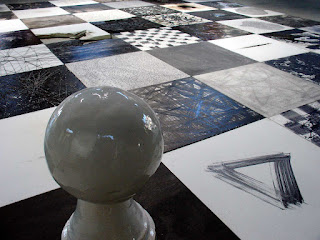
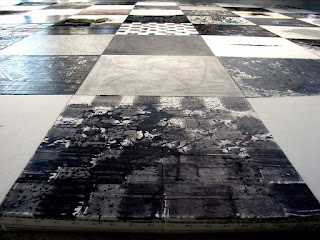
On the occasion of my completion of the First Round of The A Game, I here begin a weblog charting its progress and vagueries. These images of the board and single pawn were taken during the Line of Thought exhibition held at Paintworks, Bristol (16/05/07...).
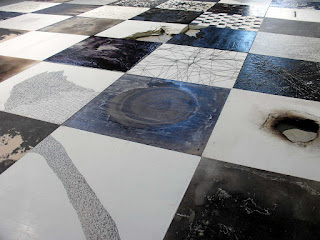
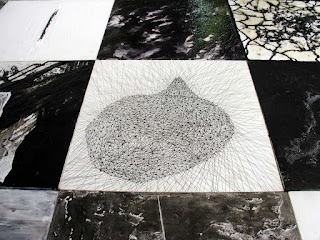
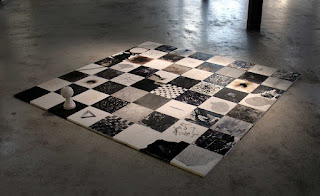 The board comprises sixty four separate tiles, each just shy of one foot square, on 3/4" fibreboard. Each was produced as an individual image and no two are the same, although motifs are echoed by more than one tile and there are several sets of tiles produced using similar techniques.
 A list of materials and equipment:
MDF
Indian Ink
Quink
Mitsubishi "Eye" Pens
Corretion Fluid
PVA
Polyfilla
Acrylic
Acrylic-based Varnish
White Emulsion
Solvent-based Gold and Silver Inks
Gesso
Porcelain
Pastel
Graphite
Grass-stains
Salt
Wax
Iron Wire
Thread
Transfer Type
Printed Map
Blowtorch
Spot-welder
Firelighting Gel
Scalpel
Axe
 The pawn was made by hand from porcelain and then fired and glazed. The Second Round of the game will involve making a full set of pieces from a variety of materials, including carved sea coal, brass and latex. I have begun my preliminary researches for the Second Round and hope to have completed the four Rooks by early 2008.
 Some points of departure:
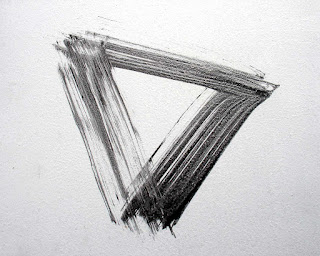
The Alphabet: The history of the Alphabet is one of abstraction and the evolution of graphic memes. Basic hieroglyphic forms which could double up as syllables in names or for use in words which had no hieroglyph were adapted by Egypt’s Semitic population for use with their own language. This altered body of signs was then eventually taken up by the Greeks, who further simplified and abstracted the images.
The original pictographic signs were worn smooth by countless hands, simplified by an endless process of Chinese whispers until they became abstract shapes. These 26 sigils were useful precisely because they are meaningless, empty signs that can be filled over and over again. With centuries of use, however, the letters of the alphabet have gained faint meaning again, not least because of the development of alphabet books for to help children memorise the letters (A is for Apple and so on).
 Chess: The evolution of the abstract chess piece follows a similar course to the alphabet, travelling hundreds of miles between people who only half understood one another. The original Indian forms were themselves the result of centuries of development, a set of complex miniature sculptures rich with symbolic detail. When chess was taken up by the Arabic world, their religious prohibition of representational images meant that new pieces were made, retaining only the rough silhouettes of the Indian originals for recognition.
 From the Middle East, these abstract pieces were taken all over Europe, and gradually over the following centuries marking and then full relief was added to the pieces in the tradition of Mediæval European carving. During this period, older abstract sets in precious materials remained in play, and many cheaper sets were made for use by the general public. These sets, often of ceramics or turned wood, were a mixture of abstract forms and representational elements because of the cost of carving.
 The abstraction and then loss of the original representational forms was a critical development, however, because it allowed a pluralism of ideas about the form and meaning of the pieces. Across Europe, pieces were made differently. This meant that during the Renaissance, new abstract forms for the pieces could be invented. Many such forms were inspired by the wood turning process. These were combined with representational crowns for each piece to aid in identification.
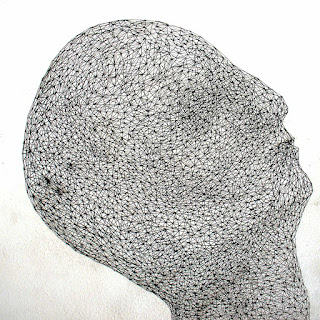
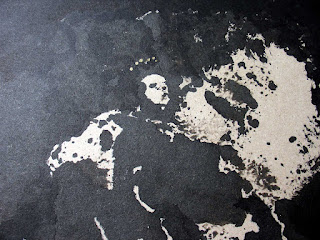 Games: There is a certain kind of looking that only comes when one is deep in a game. Attention is enhanced, narrowed. Schooled to certain stimuli, the mind overlays an invisible lacework of potential correspondences onto the eye. Relentlessly, the eye attempts to bore into the surfaces of things, only to glance off them, restlessly flitting from one knot to another and back. Looking, looking. All the while feeling the threads linking the knots, feeling the tremor of a movement in the web, feeling the fine lines like a hair under the eyelid, feeling that maddening itch of something on the edge of perception.
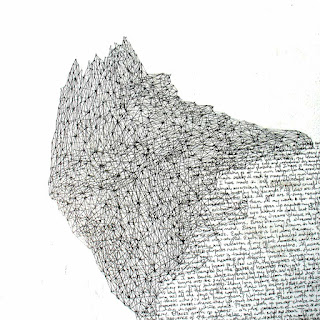 It is as though I am playing a game of chess inside myself. I can feel the subtle power of making a move, but I have not yet found how to make a board and pieces outside myself to share the game with other people. (Sometimes a calligraphic line can mirror part of the game for the instant after I draw it.) Any object can become a pawn, any word. Each square on the board contains another board. Each move is like a song.
A different game is being played out in the world, as unlike to my game as death is to life. The A Game. In this game I am less than a pawn. Lead moves into flesh. Money changes hands.
 The board comprises sixty four separate tiles, each just shy of one foot square, on 3/4" fibreboard. Each was produced as an individual image and no two are the same, although motifs are echoed by more than one tile and there are several sets of tiles produced using similar techniques.
 A list of materials and equipment:
MDF
Indian Ink
Quink
Mitsubishi "Eye" Pens
Corretion Fluid
PVA
Polyfilla
Acrylic
Acrylic-based Varnish
White Emulsion
Solvent-based Gold and Silver Inks
Gesso
Porcelain
Pastel
Graphite
Grass-stains
Salt
Wax
Iron Wire
Thread
Transfer Type
Printed Map
Blowtorch
Spot-welder
Firelighting Gel
Scalpel
Axe

 The pawn was made by hand from porcelain and then fired and glazed. The Second Round of the game will involve making a full set of pieces from a variety of materials, including carved sea coal, brass and latex. I have begun my preliminary researches for the Second Round and hope to have completed the four Rooks by early 2008.
 Some points of departure:
The Alphabet: The history of the Alphabet is one of abstraction and the evolution of graphic memes. Basic hieroglyphic forms which could double up as syllables in names or for use in words which had no hieroglyph were adapted by Egypt’s Semitic population for use with their own language. This altered body of signs was then eventually taken up by the Greeks, who further simplified and abstracted the images.
The original pictographic signs were worn smooth by countless hands, simplified by an endless process of Chinese whispers until they became abstract shapes. These 26 sigils were useful precisely because they are meaningless, empty signs that can be filled over and over again. With centuries of use, however, the letters of the alphabet have gained faint meaning again, not least because of the development of alphabet books for to help children memorise the letters (A is for Apple and so on).

 Chess: The evolution of the abstract chess piece follows a similar course to the alphabet, travelling hundreds of miles between people who only half understood one another. The original Indian forms were themselves the result of centuries of development, a set of complex miniature sculptures rich with symbolic detail. When chess was taken up by the Arabic world, their religious prohibition of representational images meant that new pieces were made, retaining only the rough silhouettes of the Indian originals for recognition.
 From the Middle East, these abstract pieces were taken all over Europe, and gradually over the following centuries marking and then full relief was added to the pieces in the tradition of Mediæval European carving. During this period, older abstract sets in precious materials remained in play, and many cheaper sets were made for use by the general public. These sets, often of ceramics or turned wood, were a mixture of abstract forms and representational elements because of the cost of carving.
 The abstraction and then loss of the original representational forms was a critical development, however, because it allowed a pluralism of ideas about the form and meaning of the pieces. Across Europe, pieces were made differently. This meant that during the Renaissance, new abstract forms for the pieces could be invented. Many such forms were inspired by the wood turning process. These were combined with representational crowns for each piece to aid in identification.
 Games: There is a certain kind of looking that only comes when one is deep in a game. Attention is enhanced, narrowed. Schooled to certain stimuli, the mind overlays an invisible lacework of potential correspondences onto the eye. Relentlessly, the eye attempts to bore into the surfaces of things, only to glance off them, restlessly flitting from one knot to another and back. Looking, looking. All the while feeling the threads linking the knots, feeling the tremor of a movement in the web, feeling the fine lines like a hair under the eyelid, feeling that maddening itch of something on the edge of perception.
 It is as though I am playing a game of chess inside myself. I can feel the subtle power of making a move, but I have not yet found how to make a board and pieces outside myself to share the game with other people. (Sometimes a calligraphic line can mirror part of the game for the instant after I draw it.) Any object can become a pawn, any word. Each square on the board contains another board. Each move is like a song.
A different game is being played out in the world, as unlike to my game as death is to life. The A Game. In this game I am less than a pawn. Lead moves into flesh. Money changes hands.
Subscribe to:
Posts (Atom)